Specialist business brokers in 8 locations across Australia.
Businesses for sale in 8 locations across Australia.
Businesses for sale in every state and territory.
Business valuations in 8 locations across Australia.
8 offices across Australia.
Start a confidential sale with a specialist broker.
What a broker adds to your price and your timeline.
What changes by state, tax and deal terms.
Brokers who already know your industry.
Understand what your business is worth.
A broker-prepared market appraisal of your business.
Fix what buyers discount before you go to market.
Prepare years ahead for a stronger result.
Businesses we have sold, by industry and state.
Free estimate in two minutes, no obligation.
Estimate what you keep after fees and costs.
How buying works, from enquiry to settlement.
The buyer process, from search to settlement.
We search off market on your behalf.
Every business currently for sale.
Browse through our specialist divisions.
What to ask for and check before you commit.
The full cash you need beyond the asking price.
Tell us what business you are after and we’ll find one with the right fit.
A free guide for buyers who are still deciding.
Independent, evidence based valuation reports.
A broker-prepared market appraisal of your business.
Which one you need, and what each is used for.
Valuers with industry specific sale data.
Confidential, no obligation discussion.
Tell us about your business to get started.
A free guide to how businesses are valued.
Find out what makes us Australia's favourite business brokers
Meet the brokers and the support team.
50+ brokers across specialist industries.
The #1 podcast for serious buyers, sellers, and anyone growing a business in Australia.
Plain-English definitions of business sale terms.
Comprehensive guide on Stamp Duty in Australia
Advice for owners preparing a business for sale.
Our dedicated valuations practice.
Self-service selling platform.
Sales and leasing alongside your business sale.
See what roles we’re currently recruiting for
Practical reading for owners and buyers.
General enquiries and head office details.
Confidential and no obligation, at a time that suits.
8 offices across Australia, with brokers nationwide.
Search by name, industry or location.
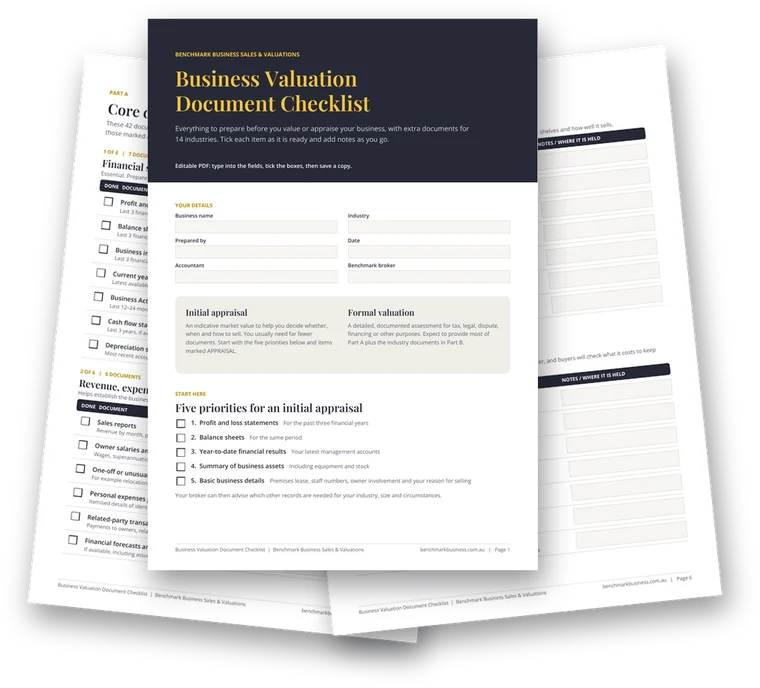
See exactly which documents to prepare before you value or appraise your business, including the extra records valuers and buyers look for in your industry.
You don’t need every document on the list to get started. How much you need to prepare depends on why you want a price for your business.
An indicative market value to help you decide whether, when and how to sell. Start with these five:
A detailed, documented assessment of value for tax, legal, finance or other formal purposes. On top of the five appraisal documents, expect to provide:
Choose what you’re preparing for and your industry, then tick off each document as it’s ready. Your progress is saved in this browser, so you can come back to it.
The core documents are much the same for every business. The extra information a valuer asks for depends on three things, and they all point to the same question: will the earnings continue under a new owner?
Weekly POS reports for a café, billings by practitioner for a medical practice, recurring fees for an accounting firm. Valuers want the records that show how your revenue is made.
Machinery for a manufacturer, the fleet for a transport business, stock for a retailer. The more a business depends on assets, the more detail a valuer needs about them.
Licences, approvals, franchise terms and major contracts can all affect whether a business transfers smoothly. These documents show a buyer what comes with the sale.
Book a confidential, no-obligation appraisal to find out what your business could sell for, or a formal valuation when you need a documented figure for tax, legal or finance purposes. Either way, our specialist brokers will review the documents on your checklist.
Not sure which you need? An appraisal gives an indicative sale price to help you decide whether to sell. A valuation is a formal report that can be relied on for tax, legal and finance purposes.
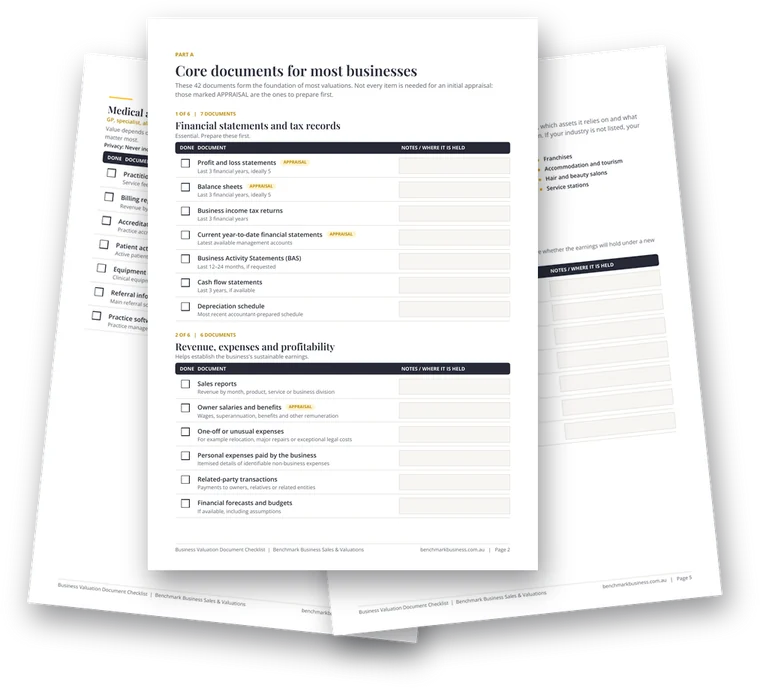
The full checklist as a 13-page PDF you can fill in on screen. Work through it with your accountant, then bring it to your first conversation with a broker.
Save the file before you fill it in. Works in Adobe Acrobat Reader, Preview on Mac and most PDF apps.
Quick answers about preparing your records for an appraisal or valuation.
Three years is a common starting point, although five years can give a clearer picture of performance and trends. If the business has been operating for less than three years, provide all the financial records you have.
Yes, an initial appraisal may still be possible. Incomplete records can limit how reliable the estimate is, and a formal valuation may need further supporting evidence.
Not usually for an initial appraisal. A valuer may ask for bank statements, general ledger reports or other evidence to verify financial results, particularly for a formal valuation or later buyer due diligence.
Some expenses may be adjusted when calculating maintainable earnings. For example, a genuinely non-recurring expense might not reflect the business’s ongoing operating costs. Any adjustment needs to be reasonable, documented and supported by evidence.
Yes. A manufacturing business may need detailed machinery and inventory records, a medical practice may need practitioner agreements and billing breakdowns, and a hospitality business may need trading reports, liquor licences and lease details. Choose your industry in the checklist above to see the extra documents for your type of business.
No. An appraisal gives an indicative market value to help with selling decisions. A formal valuation is a more detailed, documented assessment that may be needed for tax, legal proceedings, disputes, financing or other purposes.
Yes. Documents you share with a Benchmark broker are handled confidentially and used only to assess your business. The checklist itself stays in your browser or on your own computer.